Emotions as social information theory
Based on the ‘emotion as social function theory’, Van Kleef (2009) constructed the Emotion as Social Information Model (EASI). The model proposes that people’s emotions can affect others’ cognition and behavior through two paths: the affective reaction and the inferential paths. The former refers to influencing the behavior of emotional observers by providing contextual information, while the latter refers to influencing observers’ behavior by affecting their emotions and their preferences toward the expresser. Based on this model, Wang et al. (2017) found that employees’ emotional intensity affects customer loyalty and purchase decisions mainly through emotional reactions, whereas emotional authenticity affects customers’ loyalty through their inferential process. Liu et al. (2019) also found that while facing emotionally negative customers, the positive personality and effective communication of service employees can alleviate the adverse emotional impact during the service process, thereby improving the overall evaluation of service quality by customers.
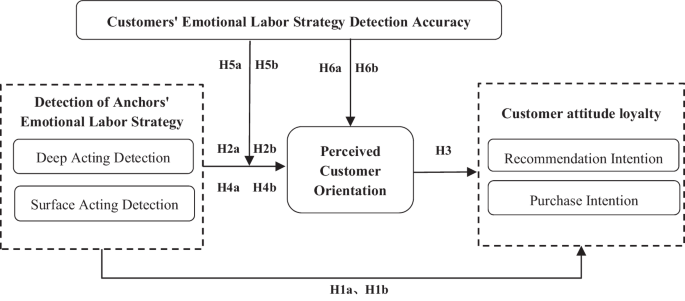
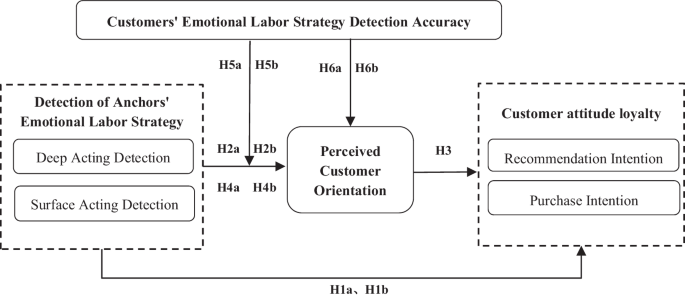
Compared to traditional service contexts, live commerce, with high emotional infectivity, allows greater transmission of emotional information (Meng et al., 2021). In this context, based on the emotional information received from anchors, customers judge whether their emotions are genuine and whether they sincerely provide service. Fake or superficial emotions will cause customers to detect anchors negatively, reducing their willingness to cooperate (Chen et al., 2024; Meng et al., 2021). Meanwhile, the sustainable development of live broadcasting requires shifting the focus from attracting consumers’ short-term purchasing behavior to cultivating long-term loyal behavior (Zhang et al., 2022a; Frennea et al., 2017). Therefore, it is particularly important to study the application of emotion as a social information theory in the context of live commerce. Based on this theory, this study constructs a theoretical model, with the detection of emotional labor strategy as the independent variable, perceived customer orientation as the mediating variable, customer attitude loyalty as the dependent variable, and the detection accuracy of emotional labor strategy as the moderating variable.
Customers’ detection of anchors’ emotional labor strategy
In the field of organizational behavior, Hochschild (1983) first proposed that an emotional labor strategy is an emotional regulation behavior. It requires employees to follow the specific requirements of the organization for service emotions during the work process to achieve effective management and expression of emotions, and divide the strategy into surface and deep acting behaviors. The former refers to individuals keeping their inner emotions unchanged and only adjusting external emotional expressions. The latter refers to achieving consistency between internal and external emotions through deep inner thought. In the context of live commerce, anchors also need to use appropriate emotional labor strategies to meet customers’ emotional needs (Zhang et al., 2024a). Therefore, this study refers to the definition of Hochschild (1983), Grandey (2000) and Itani et al. (2025) and defines the emotional labor strategy of e-commerce anchors as the process by which they actively regulate and manage their emotions in response to the emotional expression requirements of the organization, adopting a two-dimensional division of surface and deep acting behavior.
Perceived customer orientation
According to Marques (2018), customer orientation refers to the practice of enterprises or organizations to accord significance to customers’ needs, expectations, and satisfaction during their operations and decision-making. This involves actively attending to and responding to customer feedback, opinions, and preferences to provide higher-quality products, services, and experiences. Perceived customer orientation refers to the extent to which customers perceive that service personnel meet their needs within their interactions (Hennig, 2004; Stuhldreier et al., 2024). In the context of live commerce, the high contagiousness of emotions facilitates customers to perceive the anchors’ emotional investment (Meng et al., 2021). Therefore, this study considers that the definitions of Hennig (2004) and Stuhldreier (2024) are also applicable in this context, and proposes perceived customer orientation as the degree to which customers perceive the concern and fulfillment of their needs by the anchor during interactions.
Customer attitude loyalty
Compared with traditional contexts, the high interactivity of live commerce enhances the manifestation of customer attitude loyalty, which includes purchasing the live broadcast products or services and actively recommending them to others (So et al., 2025; Zhang et al., 2022a). Based on So et al. (2025) and Zhang et al. (2022a), this study measures customer attitude loyalty in terms of two dimensions: purchase intention and recommendation intention. Meanwhile, we define the purchase and recommendation intentions of customers in the live commerce context as follows. The former refers to the degree to which customers express a desire to purchase live broadcast products or services, and the latter refers to the degree to which customers are willing to recommend live broadcast products or services to others in their social networks.
Customers’ detection of anchors’ emotional labor strategy and customer attitude loyalty
Different scholars have explained the impact of emotional labor strategies on customer attitudes and behaviors differently (Groth et al., 2009; Gong et al., 2020). Specifically, Groth et al. (2009) found that employee emotional labor affects customer loyalty intention through perceived customer orientation, while Gong et al. (2020) considered that customers’ detection of employees’ emotional labor affects their loyalty through their emotions. There are differences in the mediation in the two studies. Meanwhile, So et al. (2025) pointed out that given the dynamic changes in market environments, measuring attitudinal loyalty can better identify valuable consumers. Based on this, this study believes that in the context of live commerce, compared to behavioral loyalty, attitudinal loyalty can better reflect the long-term loyalty of customers and examines how their detection of anchors’ emotional labor strategies influences their attitudinal loyalty.
Emotions as Social Information Theory suggests that the emotional information of the expresser can influence the observer’s behavior through inferential and affective reaction paths (Van Kleef, 2009, 2010). The affective reaction path indicates that when service providers naturally display genuine emotions, customers imitate these, resulting in corresponding emotional experiences (Hofmann et al., 2024). Based on this, we posit that, in the context of live commerce, the positive emotions shown by anchors through deep acting behaviors will spread to customers in the live telecast (Meng et al., 2021), stimulating positive emotions and thereby increasing attitudinal loyalty. Conversely, when anchors adopt surface-acting behaviors, the possibility of emotional contagion decreases. (Meng et al., 2021), making it difficult to arouse customers’ positive emotions. Furthermore, based on the inferential path, we posit that, in the context of live commerce, when customers perceive the anchor’s words and actions as exaggerated, they believe that he/she is not sincerely serving customers and is merely completing their tasks without considering customers’ needs (Wang et al., 2022). Thus, they evaluate the anchor negatively, thereby reducing their attitudinal loyalty. Therefore, the following hypotheses are proposed:
H1a: The detection of anchors’ deep acting behavior by customers is positively correlated with customer attitude loyalty.
H1b: The detection of anchors’ surface acting behavior by customers is negatively correlated with customer attitude loyalty.
Customers’ detection of anchors’ emotional labor strategy and perceived customer orientation
Based on the Emotion as Social Information Theory, this study demonstrates the impact of customers’ detection of anchors’ emotional labor strategies on perceived customer orientation from two aspects. On the one hand, when anchors genuinely express positive emotions to customers, the latter consciously or unconsciously perceive this information (Qureshi et al., 2024), judging whether the anchor truly cares about their needs. This process is enhanced with an increase in the anchor’s emotional authenticity. At the same time, in the “one-to-many” service scenario, customers will evaluate how well the anchor meets the needs of other customers, and the positive emotional information obtained will enhance the perception of customer orientation in the entire live room. This phenomenon is consistent with the conclusion of both Groth and Grandey (2012) that customers act as emotional transmitters in service interactions. On the other hand, when anchors do not express authentic emotions, it may lead customers to question their ability to meet needs, and reduce the probability of “emotional contagion” (Groth et al., 2009), thereby lowering the perception of customer orientation. According to the inferential path of Emotion as Social Information Theory (Van Kleef, 2009, 2010), when customers capture inauthentic emotions, they process the anchor’s emotions as social information, interpreting the latter as merely completing company tasks and not sincerely serving customers. This phenomenon is similar to the findings of Cheshin (2018), who concluded that service personnel’s exaggerated emotions cause customers to view them as insincere. Based on these two aspects, this study posits that customers’ detection of anchors’ deep-acting behavior positively affects perceived customer orientation, whereas customers’ detection of anchors’ surface-acting behavior negatively affects perceived customer orientation. The hypotheses are as follows:
H2a: The detection of anchors’ deep acting behavior by customers is positively correlated with customer attitude loyalty.
H2b: The detection of anchors’ surface acting behavior by customers is negatively correlated with customer attitude loyalty.
Perceived customer orientation and customer attitude loyalty
Based on the above measurement of customer attitudinal loyalty, this study reviews existing research to demonstrate the relationship between perceived customer orientation and customer attitude loyalty. For example, Wang (2009) and Rajaobelina et al. (2022) found that positive emotions generated from positive interactions with service personnel significantly increase customers’ satisfaction and patronage intentions, thereby prompting them to be more willing to recommend, purchase, or continue to patronize. Smith (2012) found that customer-oriented employee attitudes and behaviors promote customer loyalty. Reviewing the above research, this study finds a positive correlation between perceived customer orientation and customer attitude loyalty in service interactions. Simultaneously, this study posits that this conclusion is equally applicable to the service context of live commerce; that is, when customers feel that their or others’ needs are cared for and satisfied by the anchor, their purchase and recommendation intentions will significantly increase. Thus, the following hypothesis is proposed:
H3: Perceived customer orientation is positively correlated with customer attitude loyalty.
Perceived customer orientation as the mediator
Moreover, this study demonstrates the mediating role of perceived customer orientation through the affective reaction path of the EASI theory. The affective reaction path indicates that people usually consider the emotions of others in the same environment as clues to interpret the environment, using them as a basis for heuristic decision making. For example, people will regard an environment as pleasant and trustworthy if they feel highly positive emotions of others in the current environment, thereby increasing their willingness to cooperate (Van Kleef, 2009). Compared with the general situation proposed by this path, the live commerce context demonstrates more emotional infectiousness (Meng et al., 2021), and the role of the affective reaction path is more significant. Based on this, this study proposes that when customers perceive genuine and positive emotional information from an anchor, they generate positive emotions, regard the live room as friendly and trustworthy. Further, they believe that the anchor’s attitude towards customers is responsible, thereby increasing his/her perceived customer orientation and their purchase and recommendation intentions. Thus, the following hypotheses are proposed:
H4a: Perceived customer orientation mediates the impact of customer detection of anchors’ deep acting behavior on customer attitude loyalty.
H4b: Perceived customer orientation mediates the impact of customer detection of anchors’ surface acting behavior on customer attitude loyalty.
Customers’ emotional labor strategy detection accuracy as the moderator
Based on existing research, this study demonstrates the moderating role of customers’ emotional labor strategy detection accuracy. Liu et al. (2019) found that when customers fully perceive employees’ deep acting behavior, their trust in them increases. Furthermore, customer trust continues to increase when the perception of deep acting behavior exceeds the actual behavior of employees. In contrast, with surface acting behavior, customer trust levels first decrease and then increase as customers perceive more surface acting behavior, resulting in a U-shaped effect. Groth et al. (2009) confirmed that customers’ emotional detection accuracy can moderate the relationship between emotional labor strategies and perceived customer orientation. These studies explain the moderating role of emotional detection accuracy in general service situations and posit that the high frequency of emotional communication between anchors and customers in the live commerce context will make this effect more significant. Therefore, this study proposes that the higher the customers’ emotional detection accuracy, the stronger the positive correlation between their detection of anchors’ deep acting behavior and perceived customer orientation, and the stronger the negative correlation between their detection of anchors’ surface acting behavior and perceived customer orientation. Based on the literature discussed above, the following hypotheses are proposed:
H5a: Customers’ detection accuracy of deep acting behavior can positively moderate the relationship between their detection of anchors’ deep acting behavior and perceived customer orientation. Specifically, the more accurately customers detect deep acting behavior, the stronger the positive relationship between their detection of anchors’ deep acting behavior and perceived customer orientation.
H5b: Customers’ detection accuracy of surface acting behavior can positively moderate the relationship between their detection of anchors’ surface acting behavior and perceived customer orientation. Specifically, the more accurately customers detect surface acting behavior, the stronger the negative relationship between their detection of anchors’ surface acting behavior and perceived customer orientation.
Additionally, based on existing research in the service field (Groth et al., 2009; Winkler et al., 2025; Hennig-Thurau et al., 2006; Gong et al., 2020), this study demonstrates the moderated mediating role of customers’ emotional labor strategy detection accuracy from two aspects. On the one hand, when customers can accurately receive an anchor’s emotional labor strategy, they will have a more accurate understanding of his/her emotional transmission and interaction methods, and they can more keenly capture the emotional signals conveyed (Winkler et al., 2025; Hennig-Thurau et al., 2006; Gong et al., 2020), more accurately understand the anchor’s customer-oriented behavior, and thus are more likely to increase their attitudinal loyalty. Thus, when customers’ emotional labor strategy detection accuracy is higher, the mediating effect of perceived customer orientation on the relationship between customers’ detection of anchors’ emotional labor strategies and customer attitude loyalty will be stronger. On the other hand, when customers’ detection accuracy is low, they may not be able to identify the anchor’s acting behavior (Groth et al., 2009; Gong et al., 2020), thereby affecting their detection of the anchor’s customer orientation and attitudinal loyalty. In this case, the mediating effect of perceived customer orientation on the relationship between customers’ detection of the anchors’ emotional labor strategies and perceived customer orientation will be relatively weak. Therefore, this study proposes that the accuracy of customers’ emotional labor strategy detection moderates the mediating effect of perceived customer orientation on the relationship between customers’ detection of anchors’ emotional labor strategies and customer attitude loyalty. The following hypotheses are proposed:
H6a: The detection accuracy of customers’ deep acting behavior affects the mediating effect of perceived customer orientation on the relationship between their detection of anchors’ deep acting behavior and their attitude loyalty, which is a moderated mediating effect.
H6b: The detection accuracy of customers’ surface acting behavior affects the mediating effect of perceived customer orientation on the relationship between their detection of anchors’ surface acting behavior and their attitude loyalty, which is a moderated mediating effect.
Based on the above assumptions, the model shown in Fig. 1 was constructed.
link