
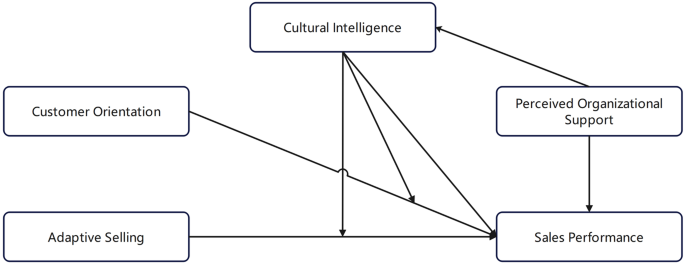
Conceptual research model
According to the previous studies, factors influencing sales performance include adaptive selling (Charoensukmongkol and Suthatorn, 2020; Kwak et al., 2019; Singh et al., 2017; Zhou and Charoensukmongkol, 2021), customer orientation (Domi et al., 2020; ELSamen et al., 2018; Lussier and Hartmann, 2016; Koshksaray et al., 2020; Pousa et al., 2018), organizational support (Kurtessis et al., 2017; Ridwan et al., 2020), etc. This paper adds CQ variables to form a conceptual research model as shown in Fig. 1.

Conceptual research model.
Structural equation modeling
As there are latent variables in the model, the structural equation model (SEM) is superior to regression analysis and path analysis. SEM is employed to estimate a system of linear equations to test the fit of a hypothesized “causal” model as shown in Fig. 1. SEM comprises two sub-models, i.e., the measurement model which estimates relationships between the observed variables and the latent variable, and the structural model, which develops the relationships between the latent variables. The measurement model is written in matrix form as Eqs. (1) and (2):
$${{x}} = \Lambda _x\xi + \delta$$
(1)
$$y = \Lambda _y\eta + \varepsilon$$
(2)
where the x and y are observed indicators (or observed variables) for latent variables (such as CQ, customer orientation, etc.); the ξ and η are exogenous and endogenous latent variables, respectively; the Λx and Λy are factor loadings; and the δ and ε are error, or disturbance, term. The structural model can be written in matrix form as Eq. (3):
$$\eta = \alpha + B\eta + \Gamma \xi + \zeta$$
(3)
where α is a intercept term, B and Γ are the coefficients, ζ is the disturbance. ζ, δ and ε are assumed to be mutually uncorrelated. Note that control variable(s) is(are) not necessary in SEM, but with appropriate control variable(s) the evaluation of the impact of predictor variables on result variable will be more accurate. In our study, some basic information, namely gender, age, education level, managerial position, experience in industry, and number of professional certificates are included in Eqs. (1–3) as control variables.
When estimating SEM, two major methods are partial least square (PLS) method and linear structural relationships (LISREL) method. PLS method combines the statistical thought of principal component analysis and multiple regression. The main components are extracted from the observation variables of different potential variables to construct the regression model, and the parameters are estimated by adjusting the weights of the main components. LISREL method is based on the covariance structure, and model parameters are estimated by fitting the model covariance and sample covariance. LISREL uses maximum likelihood estimation, generalized least squares method or other methods to construct a fitting function between the covariance of model estimation and the covariance of sample data to obtain the parameter estimation that optimizes the value of the fitting function. The partial least squares structural equation model (PLS-SEM) is employed for current analysis. The reasons for adopting this method include: first, the PLS-SEM model combines principal component analysis and multiple regression analysis to maximize the explanatory power of endogenous variables, which is vital for our analysis; second, this model does not require the data to be normally distributed, which is a necessary feature because some data, such as age, are not normally distributed in our research; thirdly, PLS-SEM model is compatible with small sample sizes, which is suitable for our research where the sample size is less than 600. This article uses Smart PLS software for data processing. ANOVA analysis and other methods will be applied where appropriate as well.
Data source
This article collects data through a questionnaire distributed to the insurance marketers of a medium-sized digital insurance brokerage company in China. There are six sections in the questionnaire (please see Supplementary Information). The first section covers the fundamental personal information and employment conditions of online insurance marketers. The second section is to measure the adaptive selling behavior of salespeople, and the questionnaire adopts the simplified ADAPTS scale of Robinson et al. (2002). The third section is to measure the degree of customer orientation of salespeople. The questionnaire is adapted from the SOCO scale of Saxe and Weitz (1982), which contains four forward measurement items and one reverse measurement item. The fourth section is a measurement of perceived organizational support. The questionnaire is adapted from the scale developed by Riggle et al. (2009), and five items are used to measure. The fifth section is to measure the CQ of the salespeople. The questionnaire is adapted from the SFCQ scale developed by Thomas et al. (2005). The measurement dimension consists of three aspects which are knowledge, skill, and cultural metacognition. The sixth section measures the job performance of the online insurance salespeople. The performance questionnaire is adapted from a scale developed by Williams and Anderson (1991), we narrow down the questions and use five items of them to measure. The results from the second to sixth section are on a Likert five-point system.
Considering the high acceptance of electronic questionnaires by online insurance marketers, the authors of this article use the “Questionnaire Star” platform to produce electronic questionnaires. With the support of the leaders of the surveyed companies, the questionnaires were distributed to more than 980 insurance marketers of the company through WeChat, a widely used social media in China, from April 21st to 25th in 2021, with a total collection of 601 questionnaires. After verification of the questionnaires, 29 were removed due to issues such as too short filling time duration, always selecting the same option, or abnormal basic information. Finally, 572 samples were accepted. The descriptive statistical results of basic information of the survey respondents are shown in Table 1:
As can be seen from Table 1, the survey subjects are mostly male, young salespeople under the age of 30, and education level is concentrated around junior college, with the majority being non-managerial members. 28% of the salespeople have not obtained any work certifications or certificates pertaining to training related to work.
Reliability analysis of questionnaire
Cronbach’s α coefficient is utilized to assess the reliability of the questionnaires. From Table 2, it can be seen that the overall Cronbach’s α coefficient of the questionnaire is 0.948, which is greater than 0.9, indicating the high reliability of the research data.
Reliability analysis was conducted on the questionnaire results of each variable, and the corresponding standardized α values are: adaptive selling 0.91, customer orientation 0.85, perceived organizational support 0.89, CQ 0.94, and job performance 0.92. According to the standardized α value, the reliability of this questionnaire is high.
Validity analysis of the questionnaire
In this paper, the validity of the questionnaire was studied with factor analysis. According to the results of Table 3, the coefficient of the KMO test is 0.947, and the significance is infinitely close to 0. The coefficient of the KMO test ranges from 0 to 1, and the closer it is to 1, the better the validity of the questionnaire will be. The value of 0.947 indicates that the questionnaire is relatively valid.
Reliability and validity analysis of the measurement model
After adjusting the questionnaire entries, the measurement model was tested for reliability and validity. According to the estimated results of the measurement model parameters in Table 4, the load values of reliability factor in this paper are all greater than 0.7, which meets the requirements, indicating that the structure explains more than 50% of the index variance, and the index setting is reliable. Cronbach’s α values are all close to 0.9, and the combined reliability CR values are all greater than 0.7, which meets the requirements and indicates good internal consistency reliability. The average variance extraction values (AVE) of the indicators which evaluate the convergence validity are all greater than 0.5, which is in line with the criteria, indicating that each scale is highly correlated with other indicators of the same construct.
In addition, from the results in Table 5, it can be seen that a load of each construct factor is all higher than its cross load with other constructs, which conforms to the judgment criterion proposed by Fornell and Larcker (1981), and the model passes the discriminative validity test.
link