
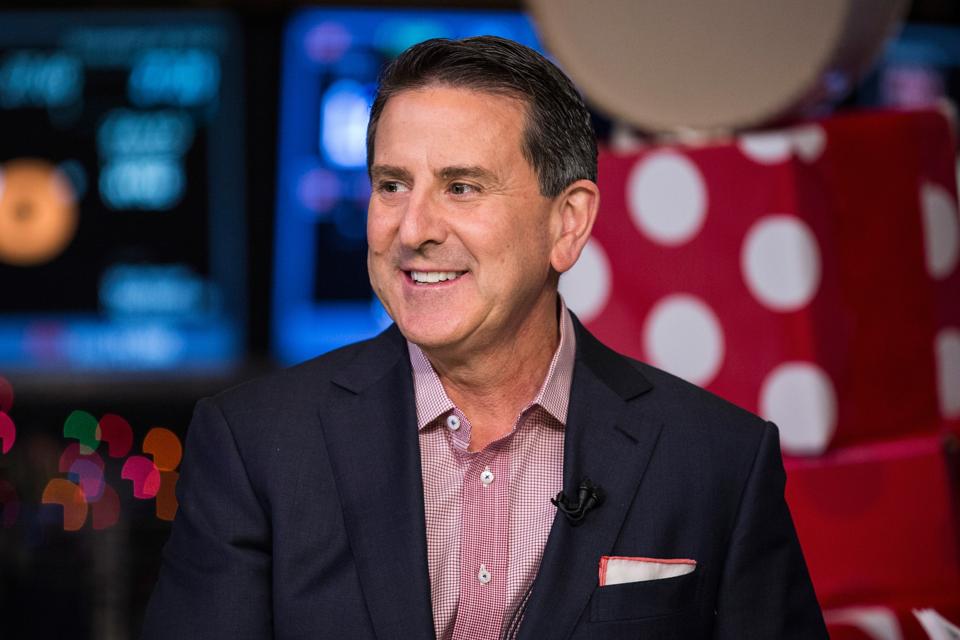
NEW YORK, NY – NOVEMBER 28: Target CEO Brian Cornell (C) appears on CNBC after ringing the opening bell at the New York Stock Exchange on the morning of November 28, 2014 in New York City. The Friday after Thanksgiving, also known as Black Friday, traditionally marks the beginning of the Holiday season. (Photo by Andrew Burton/Getty Images)
Getty Images
When Target announced on Wednesday that its CEO, Brian Cornell, would be stepping down in February, much of the story was about the company’s decline in sales, highlighted by decreasing foot traffic and a 19% decrease in profit.
And while those factors are all true, they represent more of the “what happened” than the deeper look at “why this happened.”
Target, which has been beloved by many customers across the country, had built itself up as a fun, inclusive, contemporary retailer that people looked forward to visiting when they shopped, often for goods that may be considered discretionary by its customers.
One strategic decision in January seems to have unraveled years of investment, brand trust, built-up reputation, and consumer loyalty.
Target announced it would eliminate DEI.
While the company said it concluded, rolled back, stopped or evolved its programs, consumers saw it differently.
Target’s Growth Was Built On DEI, Then It Was Cut
Upon his return to the White House earlier this year, President Trump wasted no time before issuing a Jan. 21 executive order, “Ending Discrimination and Restoring Merit-Based Opportunity.”
In that order, he addressed DEI initiatives in the public and private sector, describing them as “dangerous, demeaning and immoral.” Trump said that they “violate the text and spirit of our longstanding federal civil-rights laws,” and he added that DEI programs “undermine our national unity, as they deny, discredit and undermine the traditional American values of hard work, excellence and individual achievement in favor of an unlawful, corrosive and pernicious identity-based spoils system.”
Three days later, on Jan. 24, Target announced in a memo to employees that it was rolling back its DEI programs. Kiera Fernandez, chief community impact and equity officer at Target, wrote to employees: “Many years of data, insights, listening and learning have been shaping this next chapter in our strategy.”
“And as a retailer that serves millions of consumers every day, we understand the importance of staying in step with the evolving external landscape, now and in the future – all in service of driving Target’s growth and winning together,” she said in the memo.
Brian Cornell, Chairman and CEO of Target Corporation shakes hands with US President Donald Trump at a press conference on COVID-19, known as the coronavirus, in the Rose Garden of the White House in Washington, DC, March 13, 2020. – US President Donald Trump declared the novel coronavirus, COVID-19, a national emergency on March 13, 2020. (Photo by SAUL LOEB / AFP) (Photo by SAUL LOEB/AFP via Getty Images)
AFP via Getty Images
It was only four years earlier, in the wake of George Floyd’s murder, which happened in Target’s home state of Minnesota, that Cornell had been vocal about the brand’s need to do more:
“I recognize that it’s time to take it to another level, and that as CEOs, we have to be the company’s head of diversity and inclusion,” Cornell said. “We have to be the role models that drive change and our voice is important. And we’ve got to make sure that we represent our company principles, our values, our company purpose on the issues that are important to our teams.”
He pledged to increase black employee representation by 20% and committed to spend over $2 billion with Black owned businesses. He said he would create a program based on Target Accelerators, called Forward Founders, for early-stage start-ups led by Black entrepreneurs to help them develop, test and scale products so one day they could be in Target, and Cornell touted the fact that Target has over 50 Black-owned and Black-founded brands on their shelves in-store and online, before stating he wanted to do more.
The result: In 2021, comparable sales grew by 12.7%, on top of record growth in 2020. The company and brand were thriving. Target’s market value soared to $129 billion.
TOPSHOT – Flowers, signs and balloons are left near a makeshift memorial to George Floyd near the spot where he died while in custody of the Minneapolis police, on May 29, 2020 in Minneapolis, Minnesota. – Demonstrations are being held across the US after George Floyd died in police custody on May 25. (Photo by Kerem Yucel / AFP) (Photo by KEREM YUCEL/AFP via Getty Images)
AFP via Getty Images
It was clear that the company’s strategy, communication and evolution to tie into broader market opportunities surrounding diversity, equity and inclusion was changing the company. DEI was very, very good for business.
DEI worked so well for the retailer that Cornell had his contract extended for three more years by the company’s board of directors in September 2022, bypassing Target’s policy requiring its chief executives to retire at the age of 65. At the time, Cornell was 66.
Killing DEI Hurt Target’s Business, Value And The CEO’s Job
Soon after Target announced it was rolling back its DEI programs earlier this year, problems started to appear. In February, the backlash began among consumers Target had recently tried to embrace. In March, sales were reported as “soft”. And it was with that hint of decline — momentum building — that Pastor Jamal Bryant launched TargetFast.org, calling on 100,000 conscientious citizens to fast from spending any money at Target for the 40 days of Lent, beginning March 5 and concluding on April 20 — Easter Sunday. More than 200,000 participants responded, surpassing the participation goal. It was a boycott by a different name.
From there, LatinoFreeze.com emerged, bringing a similar message to its community. According to data from Placer.ai, for the week the boycott started, foot traffic fell 6.8% year over year at Target stores, and coincided with the timing of the 40-day “fast.”
Beyond consumers, the family members of one of Target’s cofounders beame vocal, telling the Los Angeles Times they were alarmed by the recent decision. “It is not ‘illegal’ for a company to create a business model based on what it believes to be important ethical and business standards,” Anne and Lucy Dayton, daughters of the late Bruce Dayton, said.
And online, in a Target subreddit that has been around since 2010, employees expresses their frustration too. (It should be noted that the group isn’t affiliated with or endorsed by the company.)
It was at this point the markets began to take notice. Target’s stock price (NYSE: TGT) decreased 24% —from $137.40 on Jan. 24, the day Target cut its programs, to $104.70 on March 15. To top it off, the City of Riviera Beach Police Pension Fund filed a class-action lawsuit against Target, its CEO, and board members, claiming they misled investors about the financial risks of Target’s DEI and Environmental, Social, and Governance initiatives. The plaintiffs are alleging that Target downplayed the dangers of consumer backlash and boycotts stemming from the changes.
Target’s Value Is Down 65% Since 2021, As Is Trust
While the broader market is up significantly since 2021, Target has continued to go in the opposite direction. Target’s value is now at $45 billion, down from $129 billion, as brand trust is eroding. The stock price is down to $96.40.
Target’s brand’s differentiation wasn’t just about products or pricing—it was about the trust and emotional connection customers feel based on what Target stood for in 2020. Almost overnight, they chose to change their tune, and made it appear as if their values and investment into diversity were negotiable. The result was that consumer trust eroded faster than any quarterly gains could offset.
All of this was preventable.
CHICAGO, ILLINOIS – AUGUST 16: Customers shop at a Target store on August 16, 2023 in Chicago, Illinois. Target’s quarterly sales fell for the first time in six years which is being attributed in part to consumer backlash from the sale of Pride Month merchandise. (Photo by Scott Olson/Getty Images)
Getty Images
Now The Real Work Begins
Target must not only restore growth, but it must also rebuild confidence by showing consistency between its values and its actions.
Trust these days is not a luxury; it’s a strategic asset. And one you can’t put a price tag on. It’s built over time, every single day with consistent actions that reinforce corporate values — not found in a spreadsheet.
Target’s growth was accelerated by investing in diversity, and it’s been hurt by abandoning its approach.
While outside forces are calling for the biggest companies to end DEI and destroy the so-called woke policies of the left, CEOs need to realize that growth is in new markets, in building bridges and communicating with new audiences.
The people who are so quick to take down DEI are growing their 401(k) savings accounts off the backs of what DEI is delivering.
Diversity is, and always will be, an emerging market.
And it’s not just a U.S. issue—it’s a global issue. Having traveled to 40 countries to study how diversity within different markets can help grow and sustain business, I can assure you that diversity is a trillion dollar blindspot.
And Target has let it slip away.
link