Shoe Repair Market Outlook 2025 to 2035
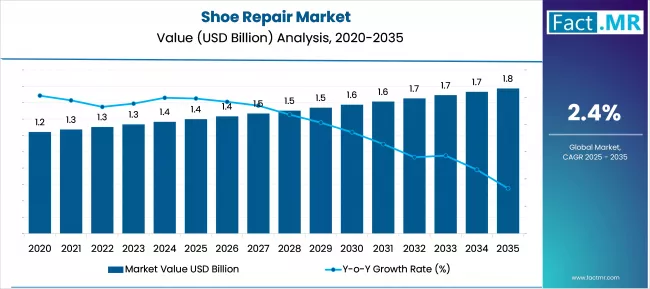
The global shoe repair market is forecast to reach USD 1.8 billion by 2035, up from USD 1.4 billion in 2025. During the forecast period, the industry is projected to register at a CAGR of 2.4%.
Rising consumer awareness about reducing waste and extending footwear life is boosting demand for repair services. Increasing footwear prices and inflation make repair a more cost-effective alternative to replacement.
Quick Stats on Shoe Repair Market
- Shoe Repair Market Size (2025): USD 1.4 billion
- Projected Shoe Repair Market Size (2035): USD 1.8 billion
- Forecast CAGR of Shoe Repair Market (2025 to 2035): 2.4%
- Leading Service Segment of Shoe Repair Market: Sole Repair
- Key Growth Regions of Shoe Repair Market: United States, China, Japan
- Prominent Players in the Shoe Repair Market: NuShoe, Inc.; Pasquale Shoe Restoration; ShoeVival Shoelaundry Pvt. Ltd; USA Shoe Company; and LEATHER SPA.
| Metric | Value |
|---|---|
| Industry Size (2025E) | USD 1.4 billion |
| Industry Size (2035F) | USD 1.8 billion |
| CAGR (2025-2035) | 2.4% |
The global shoe repair market is projected to reach an estimated USD 1.4 billion in 2025, reflecting steady demand driven by rising consumer awareness regarding sustainability and cost-consciousness. In this period, consumers increasingly prefer repairing high-quality or branded footwear rather than replacing them, which supports consistent market growth.
Additionally, the growth of urban centers, where busy professionals often seek convenient repair services, provides a steady stream of demand. Small businesses and local repair shops continue to thrive, particularly in regions where disposable income is moderate and price sensitivity is high.
The market faces gradual adoption of technological enhancements, such as improved adhesives, automated stitching machines, and online booking platforms, which are expected to enhance service efficiency. However, growth is moderate during this period, with a projected CAGR of 2.4%, due to persistent competition from inexpensive mass-produced shoes and the fast-fashion trend.
Regional variations are notable, with mature markets in North America and Europe maintaining demand for high-end repairs, while emerging markets in Asia-Pacific see slower growth due to increasing access to affordable footwear alternatives.
From 2030, the shoe repair market is expected to grow more steadily, reaching USD 1.8 billion by 2035. The rise of eco-conscious consumption and circular economy initiatives will further drive consumers toward repairing rather than discarding footwear. Digital platforms will play a more significant role, enabling on-demand repair services and broader customer reach for small and medium-sized enterprises.
Innovations in material recycling and sustainable shoe designs may expand repair opportunities, particularly for premium and athletic footwear segments. Despite the overall positive outlook, the market growth will remain moderate, constrained by ongoing competition from cheaper synthetic shoes and evolving consumer preferences favoring convenience and fast replacement. The market’s gradual expansion, combined with sustainability trends, positions shoe repair as a niche yet resilient segment within the broader footwear industry.
Analyzing Key Dynamics of the Shoe Repair Market
The shoe repair market is experiencing steady growth, driven by changing consumer attitudes toward sustainability, quality maintenance, and convenience. Increasingly, people are recognizing the value of repairing footwear instead of discarding it, which supports demand for professional services.
At the same time, the market faces challenges such as competition from cheap alternatives, limited awareness in some regions, and constraints related to skilled labor and operational costs.
Increasing Consumer Preference for Longevity and Customization in Footwear Encouraging Market Growth
Consumers are showing a stronger interest in extending the lifespan of their shoes, particularly for well-crafted or premium footwear. Repairing shoes helps maintain comfort, appearance, and performance, making it a practical choice over replacement.
Customizable repair services, such as color restoration, sole replacement, and other personalized adjustments, appeal to consumers looking for tailored solutions. This personalization fosters loyalty and repeat business for repair providers.
Adoption of Mobile and On-Demand Repair Services Expanding Market Reach
The convenience of mobile repair units and home pick-up/drop-off services is increasing accessibility for urban consumers. People can now receive repairs without visiting a shop, making professional services more attractive.
Integration with digital platforms allows customers to schedule, track, and pay for services easily. This technology-driven approach broadens market reach and attracts time-conscious, tech-savvy users.
Introduction of Eco-Friendly Materials and Innovative Repair Techniques Driving Demand
Eco-friendly adhesives, sustainable stitching materials, and recyclable components appeal to environmentally conscious consumers. Repair services adopting these solutions position themselves as sustainable alternatives to discarding shoes.
Innovations like modular soles and faster repair methods improve efficiency while maintaining quality, encouraging more consumers to choose professional repair services regularly.
Competition from Low-Cost and Mass-Produced Footwear Restricting Growth
Cheap and readily available footwear reduces the incentive to repair shoes. Many consumers prefer replacing inexpensive shoes rather than investing in professional repair.
Mass-produced shoes are often simpler to maintain at home, limiting demand for formal repair services and pressuring repair businesses to differentiate through quality or convenience.
Limited Awareness of Specialized Repair Services in Emerging Markets Hindering Adoption
In several regions, professional repair options are underutilized due to low awareness. Informal repair solutions often fail to meet quality expectations, discouraging repeat usage.
Targeted outreach, marketing, and education are essential to inform consumers about the benefits of specialized repair services and to expand the market in these areas.
Rising Operational Costs and Skilled Labor Constraints Posing Challenges
High-quality shoe repair requires skilled craftsmen, whose availability is limited in many regions. Maintaining consistent service quality can be challenging for small businesses.
Operational costs for equipment, materials, and logistics can strain profitability. Repair providers must innovate in business models and service delivery to remain competitive and sustainable.
Regional Trends of Shoe Repair Market
The shoe repair market shows varied growth across regions, driven by cultural, economic, and sustainability factors. Europe leads, supported by a strong repair culture, craftsmanship traditions in countries like France, Germany, and Italy, and policies such as France’s repair bonus and the EU’s circular economy initiatives.
North America experiences steady growth, particularly for luxury footwear, as rising prices and sustainability awareness drive consumers to repair rather than replace shoes. Digitalization, through online booking and pick-up/drop-off services, is also making repairs more convenient.
Asia Pacific is the fastest-growing market, fueled by urbanization, rising incomes, and changing lifestyles. Countries like India and China see high demand for affordable everyday repairs, while Japan and South Korea show growth in luxury-focused services.
Latin America relies on affordability and traditional craftsmanship, with strong markets in Brazil and Mexico. Meanwhile, the Middle East and Africa are emerging markets, with premium repair services in wealthier Gulf countries and cost-driven demand in African nations.
Country-Wise Outlook
| Countries | CAGR (2025-35) |
|---|---|
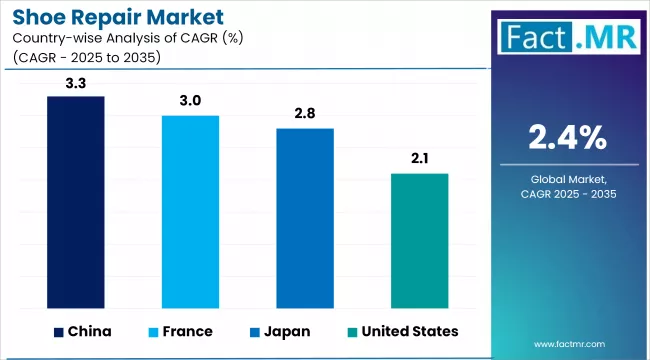
| United States | 2.1% |
| China | 3.3% |
| Japan | 2.8% |
United States Shoe Repair Market Sees Growth Driven by Mix of Sustainability Awareness
The U.S. shoe repair market is growing steadily, driven by sustainability awareness, rising footwear prices, and digital innovation. Consumers, particularly younger demographics, are increasingly mindful of the environmental impact of discarding shoes and are opting for repairs instead.
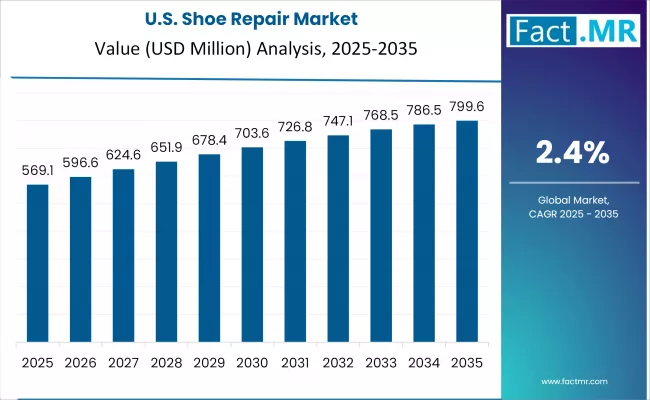
Economic pressures and high costs of branded and luxury footwear make repair a practical choice. Digital platforms offering online booking, home pick-up, delivery, and mail-in repair services are making repairs more accessible and convenient, enabling small cobblers to reach broader audiences.
- Sustainability consciousness among Gen Z and millennials is boosting demand for shoe repair
- Rising footwear costs make repairing more economical than replacing, especially for premium shoes
- Digital services like online booking and home pick-up are expanding accessibility and convenience
China Witnesses Rapid Market Growth Backed by Combination of Economic, Cultural, and Sustainability Factors
China’s shoe repair market is rapidly expanding due to rising disposable incomes, growing ownership of branded footwear, and increased awareness of sustainability. Urban consumers in cities like Beijing, Shanghai, and Guangzhou are more likely to repair high-value shoes.
Government initiatives promoting circular economy practices, coupled with social media and e-commerce platforms, are driving eco-conscious behavior. Digital platforms providing O2O solutions, home pick-up, and mail-in services are enabling repair businesses to scale nationally.
- Growth is fueled by higher disposable incomes and premium footwear ownership
- Sustainability initiatives and social media awareness are influencing repair adoption
- Online-to-offline platforms are expanding service reach and convenience for urban consumers
Japan Sees Precision Manufacturing Fuels Demand for Ultra-Pure Piping
The Japanese shoe repair market is shaped by cultural appreciation for craftsmanship, premium footwear ownership, and sustainability values. Consumers prioritize maintaining high-quality shoes and view repair to preserve investment in luxury and designer footwear.
Cost-conscious and quality-driven behaviors, along with societal trends supporting eco-friendly consumption and circular economy initiatives, reinforce market growth. Digital and social influences are also encouraging younger consumers to repair and customize shoes rather than replace them.
- Cultural emphasis on craftsmanship and quality drives demand for repair services
- Ownership of luxury and designer shoes encourages specialized repairs
- Sustainability and eco-conscious consumer behavior support ongoing market growth
Analyzing the Shoe Repair Market by Key Categories
Sole Repair Remains the Preferred Service
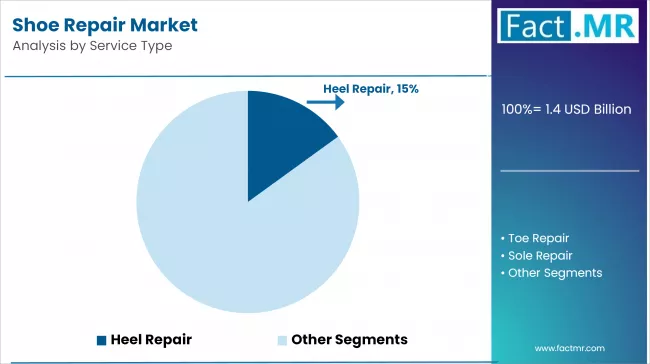
Sole repair represents the dominating segment, accounting for the largest share of service demand. Soles endure the highest level of wear and tear from daily use, making them the most frequently replaced or repaired component of footwear. This trend is particularly strong in urban areas, where consumers walk long distances and rely on durable shoes for work and daily activities.
Additionally, for premium leather shoes, boots, and branded sneakers, repairing or replacing the sole is often far more cost-effective than purchasing a new pair. The availability of advanced materials such as anti-slip rubber, lightweight composites, and water-resistant options has further boosted the appeal of sole repair services, reinforcing their dominance in the market.
- Soles experience the most wear and tear, making them the most frequently repaired component
- Repairing soles is more economical than replacing high-value footwear
- Advanced materials enhance durability and appeal, reinforcing the dominance of sole repair
Demand for Shoe Restoration Services to Rise Substantially
Restoration services are emerging as the fastest-growing segment, driven by rising consumer demand for sustainability, customization, and the preservation of high-value footwear. Restoration goes beyond basic repairs, offering services such as polishing, color re-dyeing, stitching, and refinishing to return shoes to near-original condition. This segment is particularly popular among owners of luxury shoes, designer sneakers, and vintage collections, where aesthetics and longevity are highly valued.
Younger consumers, especially Gen Z and millennials, are also fueling this growth as they increasingly view restoration not only as a sustainable choice but also as a form of personalization and self-expression. The expansion of online and mail-in restoration services is further accelerating demand, making it the most dynamic area within the shoe repair market.
- Restoration offers extensive maintenance, including polishing, re-dyeing, and refinishing
- High-value and designer shoes drive demand for specialized restoration services
- Younger consumers and digital service models are accelerating growth in this segment
Competitive Analysis
The shoe repair market is highly fragmented and competitive, shaped by a mix of traditional cobblers, small independent shops, digital startups, and brand-affiliated repair services. Independent cobblers still account for the largest share of the market globally, particularly in developing regions, where they provide cost-effective solutions for everyday footwear.
These players compete mainly on affordability, accessibility, and personalized service, but they often face challenges in scaling due to limited infrastructure, inconsistent quality standards, and reliance on manual craftsmanship. Despite this, their strong local presence and customer trust continue to give them a competitive edge in community-level markets.
In developed regions such as North America, Europe, and parts of Asia, competition is intensifying with the rise of tech-enabled startups and online platforms. Companies offering mail-in shoe repair, pick-up and drop-off services, and subscription-based maintenance models are redefining the market by focusing on convenience and customer experience.
These players leverage digital booking, tracking, and logistics to reach wider audiences while also integrating modern materials and technologies for high-quality results. Their ability to cater to busy urban consumers and tap into sustainability-conscious demographics positions them as strong disruptors against traditional repair shops.
The competitive landscape is defined by local artisanal expertise, digital convenience, and brand-driven trust. Traditional cobblers maintain dominance in affordability and accessibility, while startups and brand repair programs are expanding rapidly in higher-value markets.
The industry faces challenges such as a shrinking skilled workforce and price competition from fast fashion, which force players to innovate and differentiate. Going forward, companies that can balance craftsmanship with technology, sustainability positioning, and consumer convenience are expected to gain the strongest competitive advantage.
Key Players in the Market
- NuShoe Inc.
- Pasquale Shoe Restoration
- ShoeVival Shoelaundry Pvt. Ltd
- USA Shoe Company
- LEATHER SPA
- Cesar’s Shoe Repair
- Alex’s Shoe Repair
- Dr. Shine Shoe Repair Shop
- Minas Shoe Repair
- Chimo Shoe Repair
- PABLO’S SHOE REPAIR
- Mister Minit
- Angel’s Shoe Repair
- Broadway Shoe Repair
- Dave Page
- Cobbler
Recent Development
- In June 2025, British sustainable-fashion startup Sojo, known for clothing repair, opened its first international location in Paris, inside Westfield Les 4 Temps. This move is bolstered by France’s supportive environment, including a repair bonus, which subsidizes repair costs for clothing and footwear, and forthcoming right-to-repair legislation.
Segmentation of Shoe Repair Market
-
By Service :
- Heel Repair
- Toe Repair
- Sole Repair
- Restoration
- Stretching
-
By Customer Orientation :
-
By Region :
- North America
- Latin America
- Western Europe
- Eastern Europe
- East Asia
- South Asia & Pacific
- Middle East & Africa
link