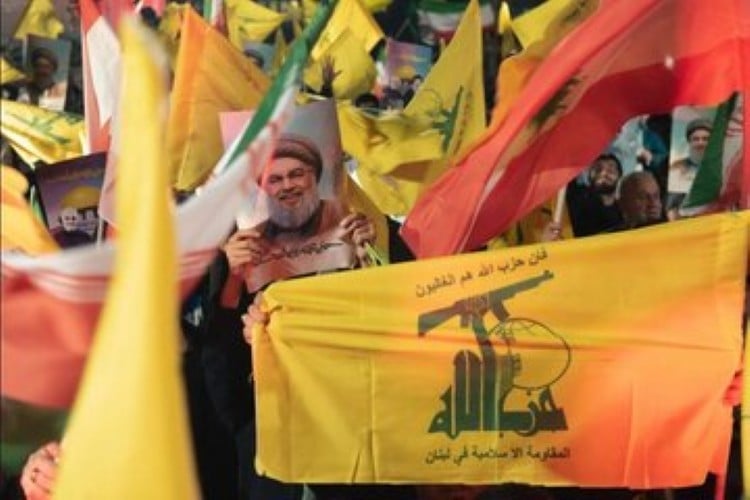
Despite leadership losses and internal strain, the Tehran-backed militia is secretly restructuring its forces and tightening control in Lebanon
A recent report by the French daily Le Figaro suggests that Hezbollah, deeply dependent on the Iranian regime, is covertly rebuilding its military and organizational structure with Tehran’s direct assistance. While the group has nominally agreed to disarm in southern Lebanon, it reportedly continues to maintain weapons elsewhere, quietly restructuring its network under Iranian supervision and through extensive internal reforms.
According to Le Figaro, the assassination of Hezbollah’s long-time leader Hassan Nasrallah initially left the organization paralyzed for several days, with communications disrupted and operations limited mainly to southern units following pre-established emergency protocols.
The report states that roughly two weeks after the assassination, operatives from the Iranian regime — led by Esmail Qaani, commander of the Quds Force of the Islamic Revolutionary Guard Corps (IRGC) — intervened to help reconstruct Hezbollah’s military apparatus. This process reportedly took around ten days, though the group’s political leadership remains vacant.
Le Figaro estimates that approximately 1,200 Hezbollah members were killed during the recent conflicts. The group’s new internal structure is described as highly secretive and based on a younger, more dynamic generation. The command chain has reportedly been shortened, with responsibilities and roles deliberately obscured to maintain operational secrecy.
Despite its military setbacks, Hezbollah is said to have retained weapons depots in the Bekaa Valley and north of the Litani River. However, according to the same report, the organization has decided to refrain from direct intervention in the event of future confrontations involving Iran, focusing instead on rebuilding and consolidating its internal structure.
The report also highlights the group’s financial struggles. The collapse of Syria’s Assad regime’s finances — one of Tehran’s closest allies — has significantly reduced Hezbollah’s sources of funding. Although limited compensation, reportedly around $12,000 per household, has been distributed to rebuild destroyed homes, these payments appear largely symbolic given the extensive devastation and the economic crisis in Lebanon.
Criticism of Nasrallah’s leadership is said to have grown within the organization, with some accusing him of involving Hezbollah in the war out of loyalty to Tehran’s regional allies while acting too cautiously to achieve tangible outcomes.
Despite this, Le Figaro notes that Hezbollah continues to wield substantial influence within Lebanon’s political system. The group still holds 27 parliamentary seats and maintains wide support among segments of the Shiite population. According to diplomatic sources, while Hezbollah may no longer pose an immediate external threat, it remains a dominant force domestically.
Intelligence assessments cited by Le Figaro describe Hezbollah as adopting a lower profile while continuing to operate discreetly — avoiding visibility but waiting for favorable conditions to act.
In conclusion, the report indicates that, under the guidance of Tehran and the IRGC’s Quds Force, Hezbollah is methodically rebuilding its command structure, tightening control over its forces, and maintaining its political base in Lebanon. Despite heavy losses, it remains one of the Iranian regime’s most important instruments of influence in the region.
link