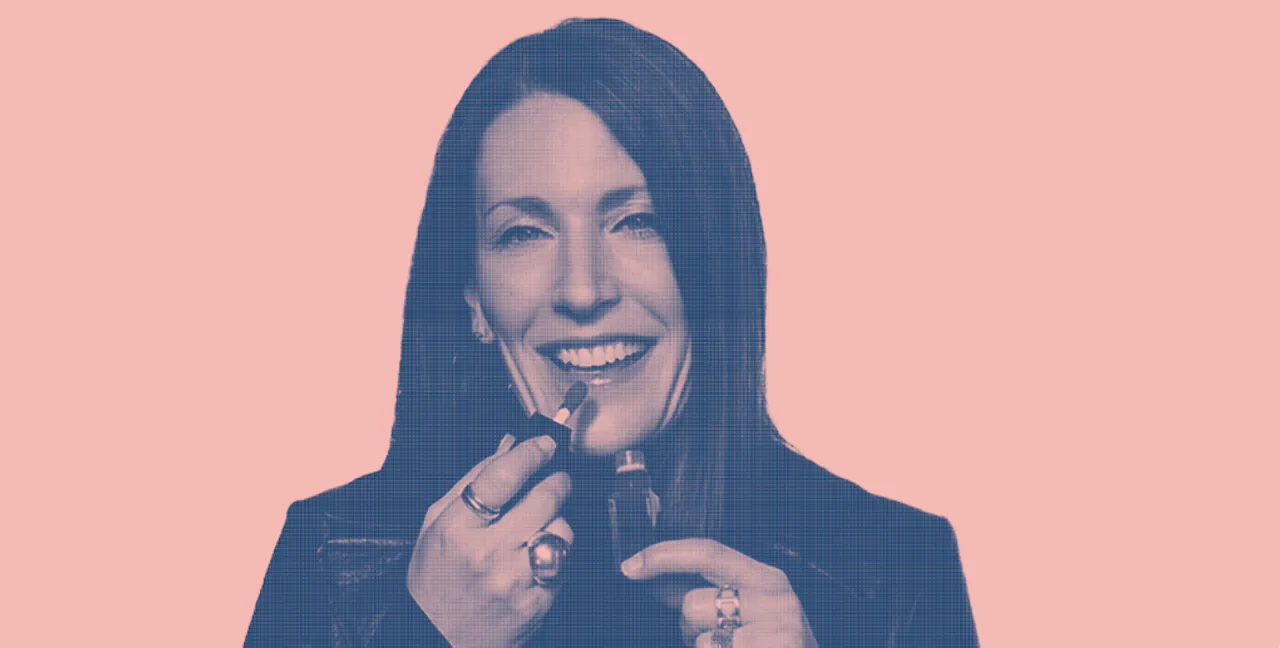
Last year, Elf became the top-selling mass market cosmetics brand in the US after increasing net sales by a whopping 31%. This success is in large part down to product innovation, marketing and a robust retail strategy, all of which fall under the remit of global chief marketing officer Kory Marchisotto.
Since its founding in 2004, the brand has been fueled by a belief that “anything is Elf-ing possible” and a mission to make beauty accessible. Since arriving in 2019, Marchisotto has further transformed it into a company that disrupts norms, shapes culture and connects communities.
Take the launch of products like Jelly Pop Primer and Bronzing Drops, its presence on platforms like Roblox and Twitch, its Super Bowl campaign or its entry into motorsports. Speaking to The Drum, Marchisotto said its ability to break through in these new and compelling ways with such regularity is only possible because of the company’s “unique” organizational structure.
Marchisotto oversees eight functional areas, including product innovation (from concept to development), as well as brand, creative, technology, communications and customer experience across both physical retail and digital channels.
“It’s very atypical that as a CMO I run end-to-end. I have everything from innovation all the way through to connected commerce and that allows us zero friction,” she says.
“In other companies, you may encounter potential friction between your brand team, creative team, and innovation team and rather than serving the community, they spend their energy figuring out how to get a project past all these different viewpoints. We’ve created a circle around the community that we serve, a zero-friction ecosystem to serve them in a meaningful way. The end-to-end organization matters.”
The breadth of Marchisotto’s responsibility is unusual, particularly in a public company of Elf’s scale. But the alternative would mean Elf couldn’t move at what’s referred to internally as “Elf speed,” a pace driven by constant feedback loops rather than rigid campaign cycles. It is also the foundation of a philosophy that now defines the brand’s growth playbook – kinetic marketing.
WTF is kinetic marketing?
Marchisotto’s approach to marketing delivered impressive results for Elf long before it was given a label. She says Rick Wolford, then a highly influential board member, was “completely enamoured” by how the marketing engine was working. “We’d created something that is pulsing and expanding in real time and he coined it ‘the kinetic marketing energy.’ That really crystallized the philosophy.”
At its core, kinetic marketing is more than a campaign framework; it’s an operating system. Rather than starting with channels, creative formats or even product roadmaps, Elf begins with community signals and cultural participation. From what they’re saying about the brand to the places they’re saying it – those signals are treated as a guide that shapes everything that follows.
“The starting point is cultivating community. We’re able to catalyze community data into insights and once we have that we co-create. We co-create content experiences, platforms, products that are for them, by them,” she explains.
“We’re constantly listening, and then with every activation that we do, we’re in a constant state of calibration. We test, we learn, we iterate and we evolve. Simply put, the more we do, the more we learn. And then with each win, the community feels a sense of purpose and belonging because they feel included. We reach people at the heart of culture. We catalyze their collective action and then that attracts even more kindred spirits, which further expands our community, which we continue to cultivate. And there you see the affinity loop as the inspiration repeats itself. That’s the kinetic marketing machine.”
Want to go deeper? Ask The Drum
What distinguishes this from reactive marketing is intentionality. Every test is designed to generate learning and every learning is expected to travel across the organization. Marchisotto says that means in the time it takes competitors to launch one campaign or product, Elf can launch 10.
It also explains why Elf has been early to platforms such as TikTok, Twitch and Roblox, and why its activations often blur the lines between beauty, entertainment and social impact. She calls it the ABC principle – audience before content – and it shapes how Elf evaluates any opportunity. Rather than chasing trends and worrying about where other beauty brands are spending their ad budgets, Elf prioritizes relevance and presence in spaces where its community already feels a sense of ownership.
“In 2019, when a lot of people were afraid of this foreign alien called TikTok, we were plunging into the deep end and doing incredible campaigns. Everybody else was still trying to figure out what the KPIs were. There’s a reason we were there – a hashtag had already been started for our brand that we had nothing to do with. 3.5 million people had been calling for Elf – so we go there and the KPIs will sort themselves out later.”
Marchisotto points to a moment that captures the essence of kinetic marketing in action. Community insight, executive access and product innovation that converged in real-time, collapsing the distance between demand and delivery.
“We asked the CEO [Tarang P Amin] to do a TikTok Live,” she recalls. The idea was that its audience could hear more about he company directly from the top and ask their most pressing questions.
“16,000 people tuned in. For that Live, we were completely bombarded with questions on bronzing drops and when we were going to launch them,” she goes on. The concept of bronzing drops (a tanning product) had come from a high-end brand. Marchisotto had been told that a purse-friendly Elf version would take at least 18 months to develop.
“They were going nuts [on the TikTok Live] – like ‘you’re boss, the decision maker, and we need bronzing drops.’ And once you have the community speaking directly to your C-suite, they’re personally invested. He ran down the hall to the innovation department and said, ‘I need bronze drops now!’” And to the delight of Marchisotto and its customers, the production of Elf Skin’s Bronzing Drops was significantly expedited and launched to the market with a campaign that humorously depicted the passion fans have for new releases.
For Marchisotto, she tells this story not to show her affinity for stunts. Instead, this is proof that when brands listen deeply and respond authentically, growth follows. It also aligns with Marchisotto’s belief that transparency strengthens loyalty. By opening up about how products are made, how decisions are taken and who is behind them, Elf reinforces the sense that the brand is participatory rather than transactional.
The same loop can be seen in the entry into motorsports, where Elf appeared at the Indy 500 to support a female driver in a male-dominated arena. Each activation fed back into the system, generating data, dialogue and creative direction that informed the next move. “That’s not a typical beauty endeavor. But when you understand the why, it actually makes perfect sense. You’ve got a growing female audience that nobody is showing up for,” she says.
And it’s the same reason it’s on Roblox and Twitch – women were already there talking about the brand.
“We had an insight that 77% of women were reporting being bullied on the platform,” she says of its entry into the Roblox world in 2023, a place many brands have tried and failed to engage with consumers. “Many [female players] were actually coming in under aliases so they could play equally in the field. We entered the platform with a channel called Elf, bringing beauty and gaming together to create a space where you can truly be yourself, unapologetically. We are now among the top 1% of brands on the platform.”
‘Audience before content’ also informs how Elf measures success. Engagement, advocacy and community contribution matter as much as impressions. This perspective allows the brand to take risks on platforms and partnerships that might look unconventional through a traditional beauty lens, but make sense when viewed through cultural alignment.
Marchisotto says that today, Elf’s communities are crying out for “more depth.” They are tired of endless social scrolling and 10-second videos and want brands to tell “a deeper story.” That means that its focus is increasingly on platforms such as Substack or podcasting.
“It’s quality over quantity. People are so bombarded all day, every day, with all of these quick nuggets. But they want to dive deeper into fewer things. And again, this is strategically calibrated for us.”
Marketing as a team sport
Marchisotto has earned enviable respect from her C-suite and boardroom colleagues. She says she often hears from peers in the marketing community that they’re not understood at the top level and struggle to build a similar organizational structure.
“That’s something that comes from an inability to communicate to different stakeholders in a language that they can understand. And I think you need to meet the moment and communicate through the ABC principle: audience before content. Who am I talking to? What do they need to hear from me in order for us to achieve the desired outcome?”
She points to the relationship she has with chief financial officer Mandy Fields, who she also convinced to feature on a Twitch Livestream to share financial insight and guidance to over 110,000 viewers.
“We’re seen as this power couple of a CMO and a CFO and it’s rare. When I started the company seven years ago, we were investing 6% of net revenue into marketing and digital. Today, that number is 25%. That doesn’t come by accident; that comes by strategically calibrated partnership and working together to showcase when something works and when it doesn’t. You need to recognize that marketing is a full-contact team sport across the entire organization.”
Kory Marchisotto has been nominated for The Drum and the World Federation of Advertisers’ Global Marketer of the Year Award 2025. Find out more about the accolade and this year’s nominees.
Previous winners of the award include Asmita Dubey, chief digital and marketing officer at L’Oréal, who won for 2023, and Marcel Marcondes, global chief marketing officer at AB InBev, who won for 2024.
link