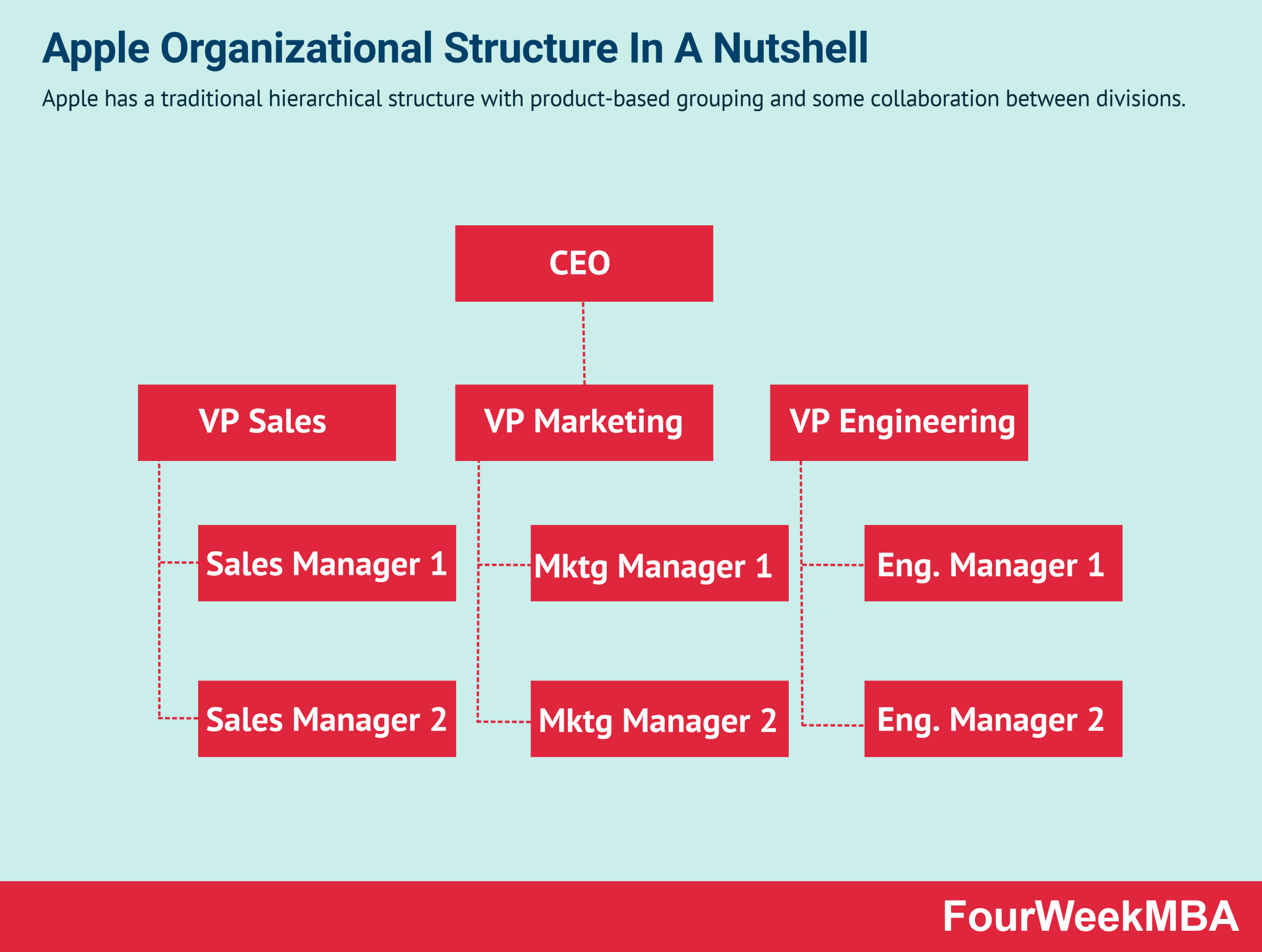
Apple has a traditional hierarchical structure with product-based grouping and some collaboration between divisions.

| Department | Type of Structure | Structure Details | Advantages | Drawbacks |
|---|---|---|---|---|
| Corporate Leadership | Hierarchy | Apple’s corporate leadership operates within a hierarchical structure. It includes the CEO, senior executives, and various departments such as hardware engineering, software development, design, marketing, retail, and finance. | – Clear lines of authority and accountability. – Efficient decision-making process. – Well-defined roles and responsibilities. | Potential slow decision-making due to multiple levels of approval. Limited flexibility in responding to rapid changes in the technology industry. |
| Hardware Engineering | Functional Structure | Apple’s hardware engineering functions follow a functional structure, with specialized teams responsible for hardware development in areas like iPhone, Mac, iPad, and wearables. | – Specialized expertise in hardware development. – Efficient management of hardware-related activities. | Potential challenges in cross-functional collaboration between hardware and software teams. |
| Software Development | Functional Structure | Apple’s software development functions, including iOS, macOS, and other software platforms, also follow a functional structure. Teams focus on developing and maintaining software for Apple’s products. | – Specialized expertise in software development. – Efficient management of software-related activities. | Potential challenges in cross-functional collaboration between software and hardware teams. |
| Design | Functional Structure | Apple’s design department follows a functional structure, with design teams responsible for product design, user interface (UI), and user experience (UX) design across various product lines. | – Specialized expertise in product design and user experience. – Consistency in design philosophy across products. | Potential challenges in integrating design considerations across different product categories. |
| Marketing and Sales | Functional and Matrix Structure | Apple’s marketing and sales operations have elements of both functional and matrix structures. While there are specialized marketing teams, cross-functional collaboration is essential to coordinate product launches and marketing campaigns. | – Specialized marketing expertise. – Collaboration between functions for effective product launches. | Potential complexity in reporting relationships and decision-making in a matrix structure. |
| Retail | Divisional Structure | Apple’s retail operations are organized with a divisional structure, with Apple Stores grouped by regions and markets. Each division has its own leadership team responsible for retail strategy, store operations, and customer experience. | – Tailored approach to different markets and regions. – Quick adaptation to local market conditions. – Specialization in retail operations. | Coordination challenges between regional retail divisions. May result in variations in store strategies and customer experiences across regions. |
| Research and Development | Functional Structure | Apple’s research and development activities follow a functional structure, with specialized teams focused on research in areas like artificial intelligence, machine learning, and hardware innovations. | – Specialized expertise in research and technology development. – Efficient management of R&D activities. | Potential challenges in aligning R&D efforts with the broader business strategy. |
| Human Resources | Functional Structure | The Human Resources function at Apple operates with a functional structure, focusing on HR-related functions such as talent acquisition, training, and employee relations. HR teams handle HR matters across the organization. | – Efficient management of human resources and talent-related activities. – Specialized expertise in HR functions. | Potential challenges in cross-functional collaboration with business units. May not align with specific business divisions. |
History of Apple
Apple Business Model
Understanding the Apple organizational structure
Former CEO Steve Jobs is credited with transforming Apple from a struggling company to one dominating the world with its innovative products.
How exactly was this accomplished?
When Jobs returned to Apple in 1997, the company had a typical product-based structure divided into business units with their own P&L responsibilities. However, Jobs noted that this approach hampered innovation.
He laid off each business unit general manager and put the entire company under one P&L, effectively combining unrelated units into one functional organization. Under this new arrangement, product managers could work insulated from short-term market pressures. They were also encouraged to share their work with other divisions to ensure innovations were not duplicated.
Jobs argued that the function-based structure required two crucial elements. First, product managers had to be product experts and not rely on others for decision-making expertise. Second, senior research and development personnel should receive a bonus based on the performance of the entire company – not simply on their own products. This gave them the freedom and impetus to focus on innovation not involving the iPhone.
Components of Apple’s organizational structure
Today, the company combines the functional and hierarchical structure instituted by Jobs with the somewhat more collaborative approach implemented by successor Tim Cook.
But there are also some other important characteristics to consider. Following is a look in general terms at the Apple corporate structure.
Hierarchical mixed with functional
Apple is a predominantly hierarchical organization. In the past, every strategic decision would have to go through Jobs. When Cook took the helm, however, he introduced a more collaborative approach between managers and employees.
To address business needs in the context of functional units, Apple employs several senior vice presidents. For instance, there are senior vice presidents for worldwide marketing, design, finance, and retail, among others. This level of management has to report to the CEO but is given more autonomy than they were under Jobs.
There are currently 10 SVPs in Apple’s executive leadership team:
- Katherine Adams – SVP and General Counsel.
- Eddy Cue – SVP Services.
- Craig Federighi – SVP Software Engineering.
- John Giannandrea – SVP Machine Learning and AI Strategy.
- Greg Joswiak – SVP Worldwide Marketing.
- Sabih Khan – SVP Operations.
- Luca Maestri – SVP and CFO.
- Deirdre O’Brien – SVP Retail + People.
- Johny Srouji – SVP Hardware Technologies.
- John Ternus – SVP Hardware Engineering.
A functional structure is more suited to the holistic culture of a compact start-up and is uncommon in a company the size of Apple. But this approach ensures there is no competition for resources between product division heads. Furthermore, it allows Apple to neglect short-term financial targets when developing resource-intensive products.
Product-based grouping
Apple also incorporates a product-based leadership model embodying the divisional approach.
Product managers (vice presidents) report to the senior vice presidents. Product managers lead product divisions responsible for iOS apps, human resources, policy, environment, and policy and social initiatives.
Ultimately, this helps the company address specific product components before releasing them to the market. It also helps Apple evaluate marketing or manufacturing requirements.
Apple employs around 100 vice presidents from a pool of 160,000 employees and, in October 2022, announced four new VPs:
- Max Muller – a 20-year veteran who became VP of Maps.
- Charlie Zhai and Fabian Klass – who became VP-level executives in the Silicon group headed by Johny Srouji, and
- Payam Mirrashidi – the new VP of engineering under Services.
Group and division collaboration
Under Jobs, hardware and software teams would have to run their ideas by the CEO with little interaction between the teams themselves.
The development of each Apple product now involves an intensive collaborative effort between various groups and divisions. In other words, some degree of functional rigidity has been sacrificed to enable creative and efficient innovation.
Comparison with Top Related Companies
- Samsung: Samsung utilizes a more complex structure, combining elements of a hierarchical corporate structure with diversified business units that operate like separate companies under the broader corporate umbrella. Unlike Apple, which centralizes decision-making and maintains a unified brand across all product lines, Samsung’s divisions like electronics, heavy industries, and life insurance operate more independently, which can lead to greater agility but also potential inconsistencies in brand and strategy.
- Microsoft: Microsoft also employs a hierarchical structure but with a strong emphasis on both function-based and product-based groups. This matrix structure facilitates better integration and cooperation between different functions and product teams, enhancing Microsoft’s ability to innovate across its software, hardware, and cloud platforms. In contrast, Apple’s structure, while also integrating product-based groups, tends to maintain stricter divisional boundaries to focus deeply on product quality and design coherence.
- Google (Alphabet Inc.): Google operates under a hybrid structure since its reorganization into Alphabet Inc., where it separates its various ventures into different entities under a corporate umbrella. This allows high levels of innovation and flexibility within each entity, such as Google, Waymo, and Verily, while maintaining overall strategic alignment at the Alphabet level. Apple’s structure is more centralized compared to Google’s, focusing on integration and control across its product lines to ensure consistency and efficiency.
Similarities and Differences
- Similarities: All these companies employ hierarchical elements within their structures to ensure clear lines of command and control. Each company also recognizes the importance of integrating various functions to promote efficiency and innovation.
- Differences: Apple maintains a more centralized control with strong product-based divisions compared to Samsung’s conglomerate model with independent business units. Compared to Microsoft and Google, Apple employs less flexibility in cross-functional collaborations, focusing more on maintaining control and consistency across its product lines.
Implications
- Innovation and Control: Apple’s structure supports strong control over its product development processes, ensuring consistency and high-quality output, which is crucial for its brand reputation. However, this may limit its ability to innovate rapidly compared to a more flexible structure like Google’s or Microsoft’s.
- Responsiveness to Market Changes: Apple’s centralized and somewhat rigid structure may slow its responsiveness to market changes compared to Samsung or Google, whose more diversified and flexible structures allow for quicker pivoting and adaptation.
- Efficiency and Specialization: Apple’s focus on product specialization and a streamlined hierarchical structure allows for efficient execution and strong specialization within product lines. This contrasts with the potential for inefficiencies or dilution of focus in more complex or diversified structures like those of Samsung or Google.
Key takeaways
- Apple has a traditional hierarchical structure mixed with elements of function and product-based grouping.
- Former CEO Tim Cook relaxed the highly rigid hierarchy present under Jobs. Instead of routing every decision through the CEO, divisional senior vice presidents and product managers are now given more autonomy.
- Collaboration between divisions and teams is now a non-negotiable part of every Apple product. This creates an environment where creative innovation has a chance to thrive.
Key Highlights
- History and Transformation: Former CEO Steve Jobs played a pivotal role in transforming Apple from a struggling company to an innovative industry leader.
- Product-Based Structure Transformation: When Jobs returned to Apple in 1997, he restructured the company from a product-based approach into a functional organization under a single P&L. This allowed for more innovation and reduced duplication of efforts.
- Key Elements of New Structure:
- Product managers became experts in their domains.
- Senior R&D personnel received bonuses based on overall company performance, encouraging innovation beyond iPhones.
- Hierarchical and Functional Mix: Apple’s structure combines a hierarchical approach with functional roles. While Jobs previously made most strategic decisions, Tim Cook introduced a more collaborative approach between managers and employees.
- Senior Vice Presidents (SVPs): Apple has several SVPs who lead functional areas such as marketing, design, finance, and operations. These SVPs have more autonomy than before but still report to the CEO.
- Product-Based Leadership Model: Apple’s structure also incorporates a product-based leadership model. Product managers report to SVPs and lead divisions responsible for specific product components, facilitating focused development and evaluation.
- Vice Presidents (VPs): Around 100 VPs are chosen from Apple’s extensive employee pool. VPs have been appointed for various areas, including Maps, Silicon group, and engineering under Services.
- Group and Division Collaboration: Apple’s approach has evolved from limited interaction between hardware and software teams under Jobs to intensive collaboration between divisions and groups. This flexibility fosters creative and efficient innovation.
- Autonomy and Innovation: Tim Cook’s changes brought more autonomy to divisional SVPs and managers, fostering an environment where creative innovation can thrive.
- Balancing Hierarchy and Innovation: Apple’s structure combines traditional hierarchical elements with a focus on innovation through collaboration and functional specialization.
Related to Apple
Who Owns Apple

Apple Business Model

Apple Business Growth

Apple Distribution

Apple Value Proposition

How Much Is Apple Worth?

Apple Cash On Hand

Apple Employees

Apple Revenue Per Employee

Apple iPhone Sales

Apple Profits

Revenue Per Employee

Apple Mission Statement

The Economics of The iPhone

Tim Cook’s Salary

Tim Cook’s Net Worth

Smartphone Market Share US

Read next:
Read Next: Organizational Structure, Apple Business Model, Apple SWOT Analysis, Apple Pestel Analysis.
Types of Organizational Structures

Siloed Organizational Structures
Functional

Divisional

Open Organizational Structures
Matrix

Flat

Connected Business Frameworks
Portfolio Management

Kotter’s 8-Step Change Model

Nadler-Tushman Congruence Model

McKinsey’s Seven Degrees of Freedom

Mintzberg’s 5Ps

COSO Framework

TOWS Matrix

Lewin’s Change Management

Organizational Structure Case Studies
OpenAI Organizational Structure

Airbnb Organizational Structure

Amazon Organizational Structure

Apple Organizational Structure

Coca-Cola Organizational Structure

Costco Organizational Structure

Costco’s geographic divisions reflect its strong presence in the United States combined with its expanding global presence. There are six divisions in the country alone to reflect its standing as the source of most company revenue.
Compared to competitor Walmart, for example, Costco takes more a decentralized approach to management, decision-making, and autonomy. This allows the company’s stores and divisions to more flexibly respond to local market conditions.
Dell Organizational Structure

eBay Organizational Structure

Facebook Organizational Structure

Goldman Sachs’ Organizational Structure

Google Organizational Structure

IBM Organizational Structure

McDonald’s Organizational Structure

McKinsey Organizational Structure

Microsoft Organizational Structure

Nestlé Organizational Structure

Nike Organizational Structure

Patagonia Organizational Structure

Samsung Organizational Structure

Sony Organizational Structure
Starbucks Organizational Structure

Tesla Organizational Structure

Toyota Organizational Structure

Walmart Organizational Structure

Main Free Guides:
Related
link